Robert Downey Jr.'s Marvel career produced one of the most remarkable increases in earning power in Hollywood history. He is widely reported to have received about $500,000 for Iron Man in 2008, while his compensation for later Avengers films reached an estimated $75 million once lucrative backend participation was included.
Working out exactly how much Downey has made from Marvel is considerably harder. His contracts are private, and published figures do not always measure the same thing. Some refer to an upfront acting fee, others include bonuses or backend participation, while annual earnings estimates can incorporate payments received from several projects.
Simply adding every Robert Downey Jr. "salary" reported online can therefore produce a misleading result.
Finance Gazette reviewed the major published estimates to distinguish upfront fees from reported backend earnings and total compensation. The figures reveal not just how much Downey was paid, but how his relationship with Marvel evolved from a relatively modest acting deal into an arrangement that allowed him to participate financially in the success of some of the highest-grossing films ever made.
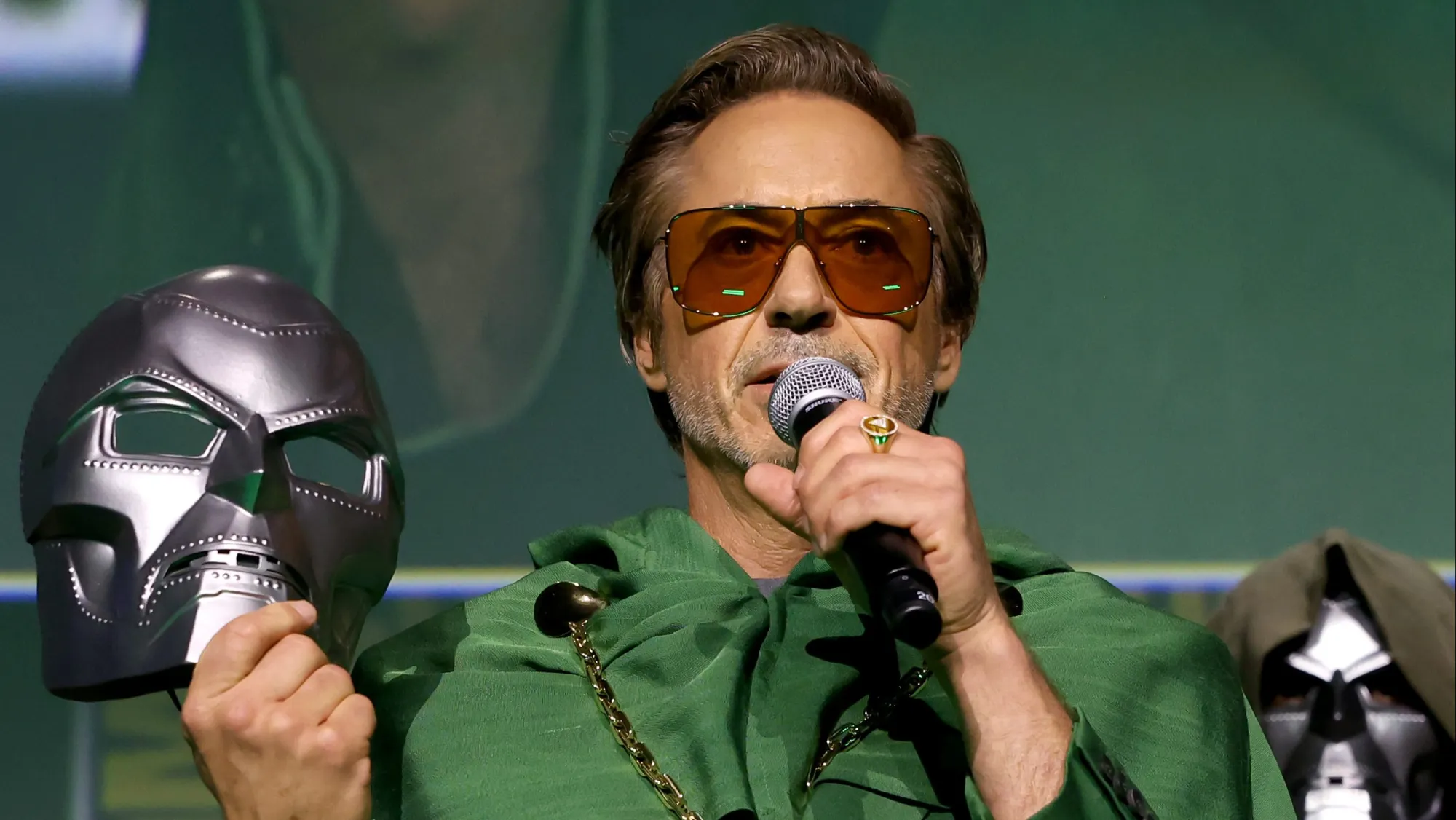
His Marvel earnings are now rising again. Downey is returning to the MCU as Victor von Doom/Doctor Doom, with Forbes reporting in 2026 that Marvel is guaranteeing him more than $100 million across its next two projects, plus substantial performance bonuses. Forbes' 2026 highest-paid actors report
| Marvel movie | Best-supported reported compensation | What the figure represents | Evidence strength |
|---|---|---|---|
| Iron Man | ~$500,000 widely reported | Initial acting fee | Medium |
| The Incredible Hulk | Not reliably disclosed | Cameo | Insufficient |
| Iron Man 2 | $10m fee; $12m additional backend subsequently estimated | Upfront fee and separately reported backend | High |
| The Avengers | ~$50m | Compensation including participation | Very high |
| Iron Man 3 | ~$75m | Frequently cited industry estimate | Medium |
| Avengers: Age of Ultron | ~$40m | Reported compensation | Medium |
| Captain America: Civil War | ~$40m+ | Reported compensation; incentives may have increased total | Medium-high |
| Spider-Man: Homecoming | ~$15m upfront | Upfront compensation | High |
| Avengers: Infinity War | At least ~$75m | Reported total compensation | High |
| Avengers: Endgame | ~$75m | $20m upfront plus ~$55m backend | Very high |
| Avengers: Doomsday / Secret Wars | More than $100m guaranteed | Package across Marvel's next two projects, plus bonuses | High |
These figures should not simply be added together and described as Downey's definitive lifetime Marvel earnings. They were reported at different times and can represent different forms of compensation.
There is no publicly confirmed figure for Robert Downey Jr.'s total lifetime earnings from Marvel.
That matters because many estimates are constructed by adding together individual movie figures even though the underlying numbers are not necessarily comparable. One might represent an upfront fee, another total compensation after bonuses and a third a backend payment recognised years after the film was released.
Iron Man 2 demonstrates the problem particularly well. Vanity Fair estimated Downey's fee for starring in the sequel at $10 million. Vanity Fair's 2009 Hollywood earnings analysis In its following annual earnings analysis, the publication separately attributed $12 million of backend income from Iron Man 2 to Downey, based on the film's worldwide gross and his share of DVD and pay-TV revenue. Vanity Fair's 2010 Hollywood earnings analysis
Those figures illustrate why describing Downey as having simply "made $10 million from Iron Man 2" does not tell the whole story. His compensation increasingly depended on more than the initial acting fee.
The most defensible conclusion is therefore that Downey has earned hundreds of millions of dollars from Marvel, but publicly available information does not support one precise lifetime total.
Downey's return to Marvel has produced another extraordinary compensation package.
Forbes reported in March 2026 that Marvel is paying him more than $100 million guaranteed across its next two projects, plus substantial performance bonuses. The precise allocation between Avengers: Doomsday and Avengers: Secret Wars has not been publicly disclosed.
That distinction matters when assessing reports that Downey is receiving "$100 million for Doomsday". The stronger evidence relates to a package covering two Marvel projects, rather than a confirmed $100 million standalone salary for one film.
Downey is also returning in a completely different role. Instead of Tony Stark/Iron Man, he will play Victor von Doom/Doctor Doom.
Marvel lists Avengers: Doomsday for release on 18 December 2026, with Avengers: Secret Wars scheduled for 17 December 2027. Marvel's official movie schedule
Downey is widely reported to have received approximately $500,000 for Iron Man in 2008, although the exact figure is less firmly documented than several of his later Marvel paydays.
What is much clearer is the scale of the commercial success that followed. Iron Man grossed more than $580 million worldwide, establishing Marvel Studios as a major force in filmmaking and dramatically strengthening Downey's negotiating position.
Using the widely reported $500,000 figure, the movie generated more than $1,100 in worldwide theatrical box-office revenue for every $1 of Downey's reported initial fee. That is not a calculation of Marvel's profit—cinemas retain part of ticket revenue and production, marketing and distribution costs also have to be paid—but it illustrates the enormous commercial scale of the film relative to his initial compensation.
The transformation in Downey's earning power becomes much clearer with Iron Man 2.
Vanity Fair estimated his upfront fee at $10 million, already 20 times the widely reported $500,000 payment for the original Iron Man. The following year, the publication separately attributed $12 million of backend income from Iron Man 2 to Downey, based on the movie's worldwide gross and his share of DVD and pay-TV revenue.
These are estimates reported in different annual earnings periods rather than a publicly disclosed contractual total. Nevertheless, they show that Downey's financial return from the film extended well beyond the initial $10 million fee.
That distinction would become increasingly important as the MCU expanded. Downey was not merely negotiating larger salaries; the financial performance of the films themselves was becoming a major component of his compensation.
Downey's approximately $50 million payday for 2012's The Avengers is one of the strongest figures available for his Marvel career.
The Hollywood Reporter had estimated that his contractual participation in the film's success pushed his earnings to around $50 million. When GQ subsequently put that number directly to Downey in a 2013 interview, he indicated that it was about right. Read GQ's Robert Downey Jr. interview
That gives the figure considerably stronger support than most celebrity salary estimates, which frequently depend entirely on unnamed industry sources.
The Avengers grossed approximately $1.5 billion worldwide, and Downey's deal demonstrated the potential value of compensation linked to a blockbuster's financial performance. His Marvel earnings were no longer determined solely by the size of his acting fee; he had negotiated exposure to the success of the franchise itself.
Downey's compensation for Iron Man 3 is frequently estimated at around $75 million, although that figure is less securely documented as a film-specific payment than his Avengers or Endgame earnings.
The distinction is worth preserving because Downey's annual earnings were also reported at around $75 million during this period. An estimate of what an actor earned over a 12-month period should not automatically be treated as the salary or total compensation attributable to one film.
For that reason, Finance Gazette treats $75 million as a frequently cited industry estimate rather than a confirmed Iron Man 3 payday.
The movie itself was another enormous commercial success, grossing more than $1.2 billion worldwide.
Downey's compensation for Avengers: Age of Ultron has been reported at approximately $40 million.
Forbes referred to the $40 million figure in connection with the film, making it a reasonable published estimate, although there is no similarly detailed public breakdown of the payment comparable with the later reporting around Endgame.
The film went on to gross approximately $1.4 billion worldwide. By this stage of the MCU, eight-figure compensation had become a recurring feature of Downey's Marvel career, reflecting the leverage he had accumulated as Tony Stark became central to the wider franchise.
Forbes reported that Downey was commanding approximately $40 million for Captain America: Civil War.
Other estimates have suggested that incentives could have pushed his eventual compensation higher, but those additional amounts are less firmly documented. The safer conclusion is therefore that his reported compensation was around $40 million, potentially rising with incentives.
Although Civil War belonged to the Captain America franchise, Tony Stark played a central role in the film, which ultimately grossed more than $1.1 billion worldwide.
Forbes estimated that Downey received approximately $15 million upfront for Spider-Man: Homecoming.
The size of the payment attracted attention because Tony Stark had a relatively limited role in the film. Rather than attempting to translate the figure into a supposed daily rate, which can be misleading when an actor's contractual obligations extend beyond days spent in principal photography, the more useful comparison is with the size of the role itself.
A reported $15 million upfront fee for a supporting appearance illustrates the commercial value that had become attached to Downey's presence and Tony Stark's connection to the wider MCU.
Downey reportedly earned at least $75 million from Avengers: Infinity War.
Reporting citing The Hollywood Reporter put his compensation at that level for the 2018 blockbuster, which went on to gross more than $2 billion worldwide.
The size of the payday illustrates how dramatically the economics had changed in the decade since the first Iron Man. Yet Avengers: Endgame provides the clearest example of that transformation because there is unusually detailed reporting on the split between Downey's initial salary and his subsequent backend compensation.
Downey's estimated $75 million compensation for Avengers: Endgame is one of the best-documented paydays of his Marvel career.
Forbes reported that he received a $20 million upfront salary and had nearly 8% of the backend pool. The extraordinary performance of Endgame translated that participation into approximately $55 million, bringing his estimated compensation from the film to around $75 million. Forbes' breakdown of Downey's Endgame compensation
In other words, roughly 73% of Downey's estimated Endgame compensation came from backend participation rather than his upfront salary.
That split is more revealing than the $75 million headline figure alone. An upfront fee of $20 million already placed Downey among Hollywood's most highly compensated actors, but the financial participation attached to his deal ultimately generated almost three times as much again.
Forbes also calculated that Endgame generated approximately $36.90 in theatrical box-office revenue for every dollar Downey was paid. As with the earlier comparisons, box-office revenue should not be confused with studio profit, but it provides useful context for the scale on which these compensation arrangements operated.
The change in Downey's earning power can be illustrated by comparing the widely reported payment for his first Marvel movie with his later Avengers compensation.
His reported Iron Man fee was approximately $500,000, while his estimated total compensation from Avengers: Endgame reached around $75 million. On those figures, his compensation increased 150-fold, equivalent to approximately 14,900%.
There is an important caveat: this is not a like-for-like comparison between two upfront salaries. The $500,000 figure is generally described as Downey's initial Iron Man fee, whereas the $75 million Endgame estimate includes approximately $55 million of backend compensation.
That difference is also the point. Downey's financial transformation was not simply the result of negotiating progressively larger acting fees; his growing bargaining power allowed him to participate directly in the financial success of Marvel's biggest films.
Celebrity salary reporting tends to use the word "salary" for several different forms of compensation.
An upfront salary is the guaranteed fee for appearing in a film. Performance bonuses can become payable when contractual targets are reached, while backend or contingent compensation gives talent a financial interest tied to a movie's commercial performance.
Those distinctions are particularly important in Downey's case because the terms of his Marvel agreements were private and his later backend payments could be worth substantially more than his initial salary.
As a result, one publication might report an upfront fee when a movie enters production, another might estimate a backend payment after its theatrical release, and a third might calculate the actor's overall annual earnings. All three figures can describe genuine payments while answering different questions.
This is why Finance Gazette does not produce a definitive lifetime Marvel total by simply adding together the most commonly reported movie figures.
The Endgame deal provides the clearest illustration of the economics.
Downey's estimated $55 million backend payment was approximately 2.75 times his $20 million upfront salary. Had his compensation ended with the initial fee, his payday would still have been exceptional; participation in the movie's success transformed it into something far larger.
Forbes reported at the time that established Marvel stars had been able to negotiate contingent compensation because of the leverage they held over the studio's biggest films. Forbes' analysis of Marvel contingent compensation For Downey, that arrangement became central to the financial story of his Marvel career.
His progression therefore says something broader about Hollywood economics. A successful actor can command a large salary, but a star who becomes sufficiently important to a multibillion-dollar franchise can potentially negotiate participation in the value the film creates.
Before his return as Doctor Doom, Downey appeared in ten MCU films: Iron Man, The Incredible Hulk, Iron Man 2, The Avengers, Iron Man 3, Avengers: Age of Ultron, Captain America: Civil War, Spider-Man: Homecoming, Avengers: Infinity War and Avengers: Endgame.
Together, those films generated well over $12 billion in worldwide theatrical box-office revenue.
That total should not be interpreted as revenue personally generated by Downey, and worldwide box office is not equivalent to studio profit. Cinemas retain part of ticket sales, while production, marketing and distribution costs can be substantial.
It does, however, provide essential context. Downey's compensation increased so dramatically because his bargaining power was developing within films operating at an extraordinary commercial scale.
The final figure could depend on considerably more than Downey's guaranteed compensation.
Forbes reported in March 2026 that Marvel is guaranteeing him more than $100 million across its next two projects, plus substantial performance bonuses. If those bonuses are tied to commercial targets, his eventual compensation could exceed the guaranteed amount, although the underlying contract has not been made public.
For now, the important distinction is between what has actually been reported and what remains unknown. There is strong current reporting for a package worth more than $100 million across two projects; there is not equivalent evidence establishing exactly how much belongs to Doomsday, how much belongs to Secret Wars, or how much Downey will ultimately receive once bonuses are included.
So, how much did Robert Downey Jr. make from Marvel?
There is no reliable public figure for his exact lifetime earnings, and a precise total constructed from individual movie "salaries" risks combining different types of compensation.
What the stronger reporting does establish is remarkable enough. Downey is widely reported to have started with an approximately $500,000 fee for Iron Man. Vanity Fair subsequently estimated a $10 million fee for Iron Man 2 and separately attributed $12 million of backend income from the sequel to him. Downey himself broadly confirmed the approximately $50 million Avengers estimate, while reporting around Infinity War placed his compensation at at least $75 million.
For Endgame, the evidence is clearer still: Forbes estimated approximately $75 million, comprising a $20 million upfront salary and around $55 million in backend participation.
Now, as Doctor Doom, Downey is guaranteed more than $100 million across Marvel's next two projects, plus substantial performance bonuses.
The defining financial story is therefore not simply that his reported Marvel compensation rose from roughly $500,000 to $75 million-level paydays. It is that Downey moved from receiving an acting fee to possessing enough negotiating leverage to participate directly in the financial success of one of Hollywood's biggest franchises.
There is no confirmed lifetime total. Public reporting establishes hundreds of millions of dollars in Marvel compensation, but the available figures mix upfront fees, backend payments and estimates made at different times.
Downey is widely reported to have received approximately $500,000 for Iron Man in 2008, although the precise figure is less firmly documented than several of his later Marvel paydays.
Vanity Fair estimated a $10 million starring fee and subsequently attributed $12 million of backend income from Iron Man 2 to Downey.
Approximately $50 million. When GQ asked Downey whether The Hollywood Reporter's estimate was about right, he indicated that it was.
His compensation is frequently estimated at around $75 million, but the figure is less securely documented as a film-specific payment than his Avengers or Endgame earnings.
Downey reportedly earned at least $75 million from Avengers: Infinity War.
Forbes estimated approximately $75 million, consisting of a $20 million upfront salary and roughly $55 million generated by backend participation.
Forbes estimated that Downey received approximately $15 million upfront for his appearance in Spider-Man: Homecoming.
Forbes reported in 2026 that Marvel is guaranteeing Downey more than $100 million across its next two projects, plus performance bonuses. The amount attributable specifically to Avengers: Doomsday has not been publicly disclosed.
No. Downey is returning to the MCU as Victor von Doom/Doctor Doom. Avengers: Doomsday is scheduled for release on 18 December 2026.
Finance Gazette reviewed contemporary and subsequent reporting on Robert Downey Jr.'s Marvel compensation, giving greater weight to direct interviews and established business and entertainment publications.
Where a source reports an upfront fee, Finance Gazette does not automatically treat that amount as the actor's eventual earnings from the film. Separately reported backend compensation is identified as such, while figures that cannot be tied confidently to an individual movie are described as estimates rather than confirmed payments.
The approximately 150-fold increase, 14,900% increase, 73% backend share of estimated Endgame compensation and 2.75-to-one relationship between Endgame backend compensation and upfront salary are Finance Gazette calculations based on the reported figures described above.
This approach avoids one of the central problems with celebrity salary estimates: combining figures that measure different forms of compensation and presenting the result as a definitive lifetime total.
I would publish with these external links and no more. The strongest sources are linked exactly where a publisher or reader would want to verify the underlying evidence, without covering the article in outbound links.