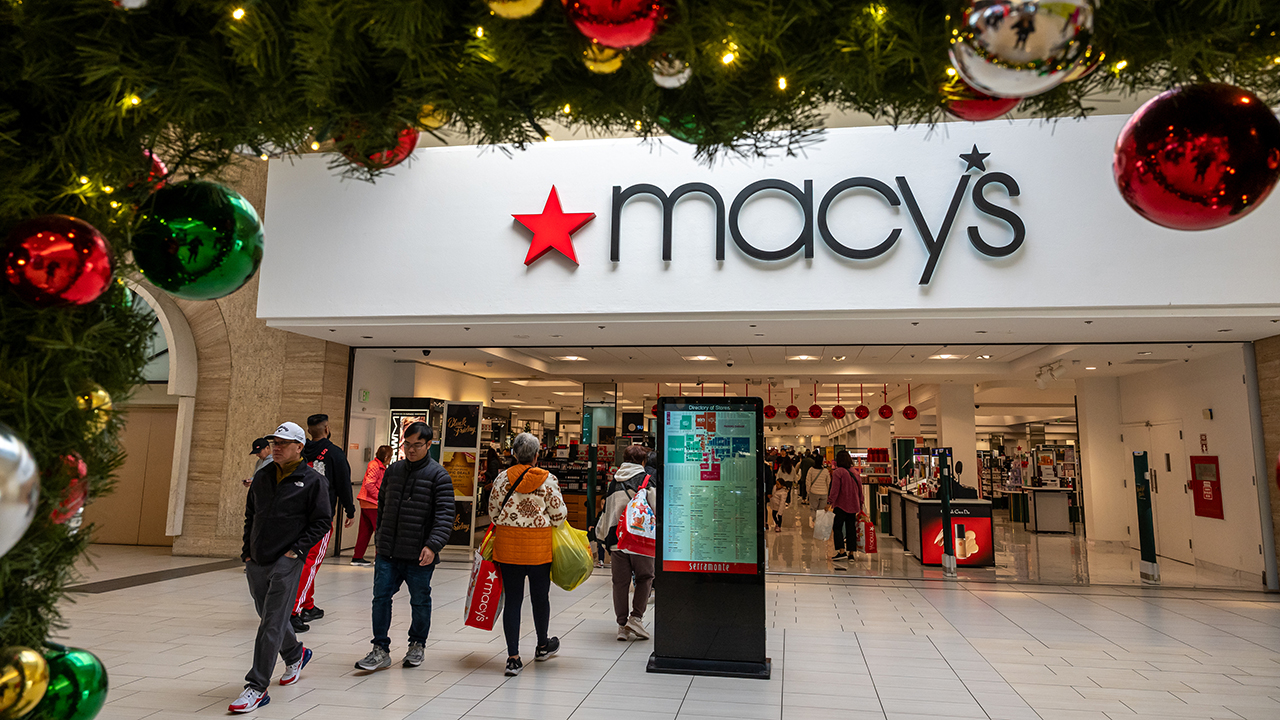
Macy’s has raised its full-year sales and profit forecasts after stronger second-quarter trading at Bloomingdale’s and Bluemercury, according to results reported by Reuters on Thursday.
The US department-store group now expects fiscal 2026 net sales of $21.68 billion to $21.83 billion, compared with its previous forecast of $21.50 billion to $21.75 billion.
Adjusted earnings guidance has also been increased to $2.15 to $2.35 per share, from $2.00 to $2.20 previously.
Second-quarter sales increased 1.1% to $4.87 billion, ahead of the $4.83 billion analyst estimate cited by Reuters. Adjusted quarterly profit rose 80% to 63 cents per share.
Macy’s shares were around 5% higher in premarket trading following the results.
The figures show a substantial difference in performance across the company’s three principal retail brands.
Comparable sales at Bloomingdale’s increased 11.3%, while beauty and skincare business Bluemercury recorded growth of 6.2%. Comparable sales at the Macy’s nameplate increased 1.1%.
Bloomingdale’s comparable-sales growth was therefore approximately 10.3 times the rate reported by Macy’s stores.
That is a Finance Gazette calculation, based on the reported 11.3% and 1.1% comparable-sales growth figures, and illustrates the extent to which the higher-end chain outperformed the core Macy’s business during the quarter.
Chief executive Tony Spring has been pursuing the company’s “Bold New Chapter” strategy since 2024, including closing underperforming stores and directing resources towards stronger locations and higher-end businesses.
Macy’s said tariff refunds contributed 23 cents per share to quarterly earnings and that it has received $116 million in refunds so far.
Compared with adjusted quarterly earnings of 63 cents per share, the reported tariff-refund contribution was equivalent to approximately 36.5% of adjusted EPS.
That is a Finance Gazette calculation — 23 cents divided by 63 cents — and provides useful context for the reported 80% increase in adjusted quarterly profit.
The company said its forecasts take account of macroeconomic and geopolitical uncertainty that could affect consumer spending, as well as the benefit from tariff refunds.
The latest sales guidance also represents an improvement from the expectations Macy’s set at the beginning of the financial year.
In its previously published full-year results, Macy’s forecast fiscal 2026 net sales of $21.4 billion to $21.65 billion, with adjusted diluted earnings of $1.90 to $2.10 per share.
The latest reported sales forecast of $21.68 billion to $21.83 billion therefore places the bottom of the new range $30 million above the top of the original range.
That comparison provides a clearer measure of how Macy’s expectations have changed during the year than the latest upgrade alone.
The difference in brand performance is equally significant. Bloomingdale’s 11.3% comparable-sales increase and Bluemercury’s 6.2% growth considerably exceeded the 1.1% recorded at Macy’s, leaving the group’s higher-end businesses as the strongest growth contributors in the reported quarter.